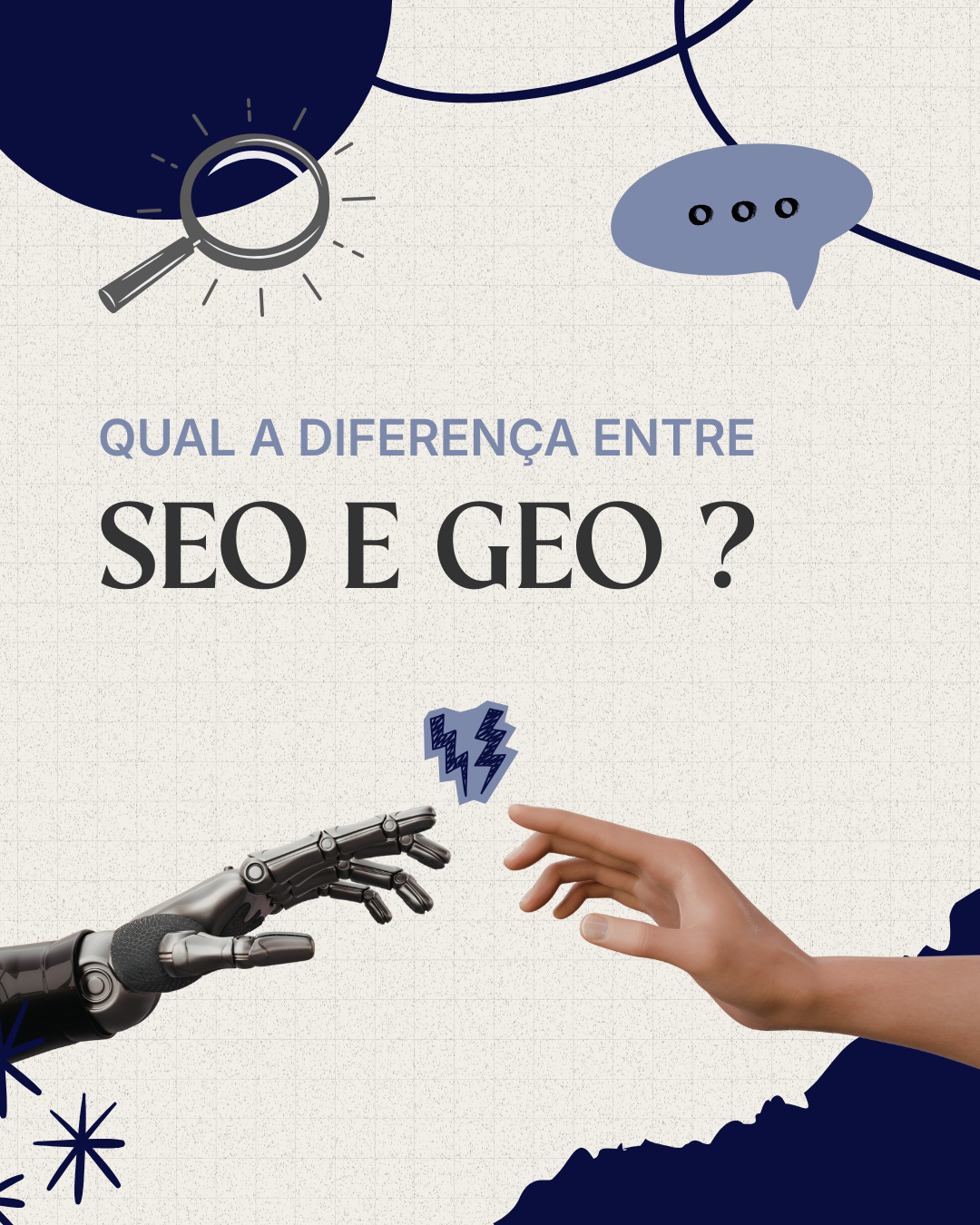
Digital marketing is constantly evolving, and with the rise of generative artificial intelligence, a new term has started to gain attention: GEO. Many people still confuse this concept with traditional SEO, but the truth is that they are distinct—although complementary—strategies for those who want to gain online visibility.
In this article, we will explain in a simple way the difference between SEO and GEO and why both will work side by side in the coming years.
What Is SEO?
SEO stands for Search Engine Optimization. It is a set of techniques that help your website rank higher in organic results on Google or other search engines.
With SEO, we work on keywords, site structure, relevant content, internal and external links, loading speed, among other factors. The goal is clear: to attract more visitors through searches made by real users, without paying for each click.
If someone searches for “lawyer in Lisbon” or “best coffee shop in Porto,” and your website is well optimized for SEO, the chances of appearing among the top results increase significantly.
What Is GEO?
GEO, or Generative Engine Optimization, is a more recent concept connected to the use of AI-powered answer engines, such as ChatGPT, Bing with AI, and other tools that generate responses instead of simply displaying links.
While traditional SEO focuses on search results, GEO is concerned with how brands and content are presented within AI-generated answers. Instead of competing for a position on Google, the challenge becomes being cited or recommended by generative tools.
To achieve this, content must be adapted using clear language, reliable sources, well-structured information, and accessible data for generative models. GEO requires a new way of thinking about content—more oriented toward natural language, context, and authority.
SEO and GEO: Rivals or Allies?
In reality, SEO and GEO are complementary strategies. SEO remains essential for visibility in traditional search engines, while GEO emerges as a response to how people increasingly consume information through artificial intelligence.
If the key question used to be “How do I appear on Google?”, now it is also “How can I be cited by ChatGPT or Perplexity’s engine?”. To achieve that, it is not enough to simply be online—you need to be relevant, clear, and trustworthy in the eyes of AI systems.
Conclusion
The main difference between SEO and GEO lies in the final destination of the search. SEO focuses on traditional search engines, while GEO focuses on generative answer engines. Both share the same goal—giving visibility to your brand—but adapt to different content consumption behaviors.
If your business wants to prepare for the future of digital marketing, it needs to understand and apply both approaches. Being well positioned on Google and within AI-generated answers will become the new standard of online authority.